
By Gary Spokes, Managing Director – GJS Business Solutions and Training
Ankle injuries are among the most common musculoskeletal injuries, especially for athletes, tradespeople, and those who engage in physical activity. While most people are familiar with a standard ankle sprain, fewer have heard of a syndesmosis injury, which is a more severe and complex type of ankle sprain.
In this blog, I’ll break down the differences between a syndesmosis injury and a normal ankle sprain, explaining their causes, signs, symptoms, and the best treatment methods, including the RICE method. If you’re in a high-risk industry or play sports, understanding these injuries can help you take precautions and recover more effectively if you do get injured.
What Is a Normal Ankle Sprain?
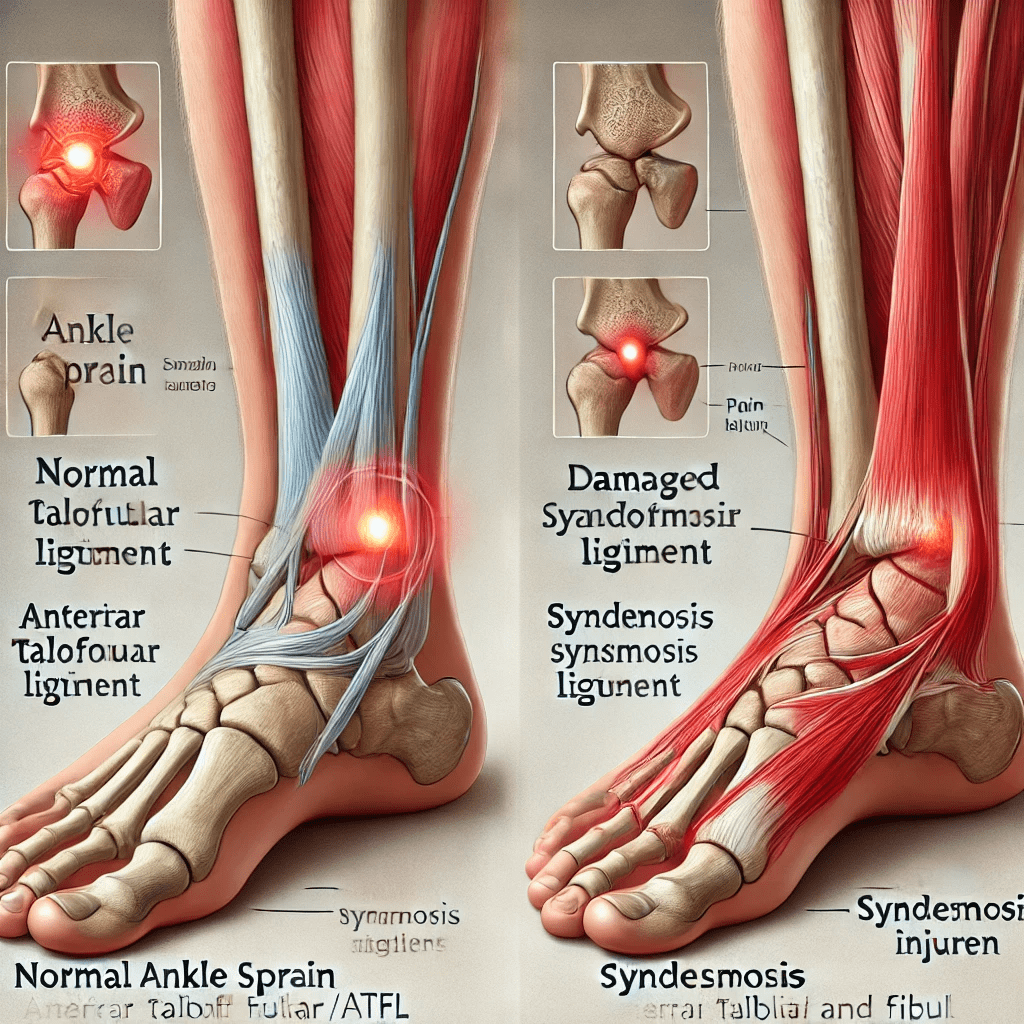
A normal ankle sprain occurs when the ligaments that support the ankle joint are overstretched or torn due to excessive twisting or rolling of the foot. The most commonly injured ligament is the anterior talofibular ligament (ATFL), located on the outside of the ankle.
Causes of a Normal Ankle Sprain:
• Rolling the ankle inward or outward while walking or running on uneven surfaces
• Landing awkwardly after a jump (common in sports like basketball and netball)
• Sudden changes in direction (common in football or soccer)
• Missteps, such as stepping off a curb incorrectly
Signs and Symptoms of a Normal Ankle Sprain:
• Mild to moderate pain around the ankle
• Swelling and bruising
• Limited range of motion due to pain
• Tenderness when pressing on the injured area
• Mild instability, especially if the ligament is completely torn
Severity Levels:
• Grade 1: Mild stretching of the ligament, minimal swelling and pain
• Grade 2: Partial tearing of the ligament, moderate pain, swelling, and bruising
• Grade 3: Complete ligament tear, severe pain, major swelling, and instability
What Is a Syndesmosis Injury?
A syndesmosis injury, often called a high ankle sprain, is a more severe and complex injury than a normal ankle sprain. It involves damage to the syndesmosis ligament, which connects the tibia and fibula (the two bones of the lower leg). This ligament is crucial for stability and helps maintain the proper spacing between these bones.
Causes of a Syndesmosis Injury:
• Twisting or rotating the foot outward while the leg is planted (common in rugby, football, and skiing)
• Direct impact or trauma to the lower leg or foot
• Falling and landing in a way that forces the foot outward
Signs and Symptoms of a Syndesmosis Injury:
• Pain above the ankle joint (rather than directly on the ankle)
• Difficulty walking or putting weight on the foot
• Significant swelling and bruising
• Feeling of instability, especially when standing or moving
• Pain when squeezing the tibia and fibula together
A syndesmosis injury is typically more serious than a normal ankle sprain and often requires a longer recovery period. In severe cases, it may require surgery.
Key Differences Between a Normal Ankle Sprain and a Syndesmosis Injury
Understanding the differences between a normal ankle sprain and a syndesmosis injury is essential for proper diagnosis and treatment. While both affect the ankle, they impact different ligaments, have distinct causes, and require different recovery approaches.
1. Location of Injury
• A normal ankle sprain occurs at the outer or inner ankle, usually affecting the anterior talofibular ligament (ATFL) or calcaneofibular ligament (CFL).
• A syndesmosis injury occurs above the ankle joint, affecting the syndesmosis ligament, which connects the tibia and fibula.
2. Ligaments Affected
• In a normal ankle sprain, the most commonly injured ligaments are the ATFL and CFL on the outside of the ankle.
• A syndesmosis injury involves damage to the syndesmosis ligament, which helps stabilize the lower leg bones.
3. Cause of Injury
• A normal ankle sprain usually results from rolling or twisting the ankle inward or outward, often from uneven surfaces, missteps, or sudden directional changes in sports.
• A syndesmosis injury is caused by a forceful rotation of the foot outward while the leg is planted, commonly occurring in contact sports or from direct trauma.
4. Pain Location and Symptoms
• Pain from a normal ankle sprain is typically felt around the ankle joint, with swelling, bruising, and tenderness in that area.
• A syndesmosis injury causes pain above the ankle joint, often extending up the leg, with more severe swelling and difficulty bearing weight.
5. Weight-Bearing Ability
• In mild to moderate ankle sprains, walking may be possible with discomfort.
• A syndesmosis injury often makes walking extremely painful or impossible without crutches due to the instability between the tibia and fibula.
6. Swelling and Bruising
• A normal ankle sprain results in moderate swelling and localized bruising around the ankle.
• A syndesmosis injury tends to cause significant swelling that extends higher up the leg, sometimes with bruising appearing days later.
7. Recovery Time
• A mild to moderate ankle sprain usually heals within 2 to 6 weeks, depending on severity.
• A syndesmosis injury requires a longer recovery, often 6 to 12 weeks, and in severe cases, surgery may be needed to restore stability.
By recognising these key differences, individuals can seek the right treatment and avoid long-term complications. If you suspect a syndesmosis injury, it’s crucial to see a medical professional for a proper diagnosis and treatment plan
Treatment: The RICE Method
Both normal ankle sprains and syndesmosis injuries require immediate treatment to reduce pain, swelling, and long-term complications. One of the best first-aid approaches is the RICE method, which stands for Rest, Ice, Compression, and Elevation.
1. Rest
• Avoid putting weight on the injured foot.
• Use crutches or a brace if necessary.
• If it’s a syndesmosis injury, non-weight-bearing is crucial for healing.
2. Ice
• Apply an ice pack wrapped in a towel to the injured area for 15-20 minutes every 2-3 hours during the first 48 hours.
• Reduces swelling and numbs the pain.
3. Compression
• Use an elastic bandage or ankle brace to reduce swelling and support the joint.
• Avoid wrapping too tightly, as this can cut off circulation.
4. Elevation
• Keep the injured ankle elevated above heart level as much as possible.
• Helps reduce swelling and speeds up recovery.
Additional Treatment Options:
• Pain Management: Over-the-counter pain relievers like ibuprofen or paracetamol can help reduce pain and inflammation.
• Physiotherapy: Strengthening and mobility exercises help restore movement and prevent further injury.
• Medical Evaluation: If you suspect a syndesmosis injury, see a doctor immediately. X-rays or MRIs may be needed to assess the damage, and in severe cases, surgery may be required.
When to Seek Professional Help
While mild ankle sprains can often heal with the RICE method, you should seek medical attention if:
• The pain is severe and does not improve after a few days.
• You are unable to bear weight on the injured foot.
• There is significant swelling, bruising, or deformity.
• The injury occurred from a high-impact trauma or twisting motion (which may indicate a syndesmosis injury).
A syndesmosis injury should always be evaluated by a medical professional to determine whether surgery or extended immobilization is required.
Prevention Tips for Ankle Injuries
While accidents happen, you can take steps to reduce your risk of ankle sprains and syndesmosis injuries:
• Warm-up properly before exercise or work.
• Wear appropriate footwear that supports the ankle.
• Strengthen ankle muscles with balance and stability exercises.
• Avoid uneven surfaces where possible.
• Use ankle braces or taping if you have a history of ankle injuries.
Conclusion
Understanding the difference between a normal ankle sprain and a syndesmosis injury is crucial for proper treatment and recovery. While a mild ankle sprain may heal within weeks, a syndesmosis injury can require months of rehabilitation and even surgery in severe cases.
If you work in high-risk industries, play contact sports, or simply want to be prepared, knowing how to identify and treat these injuries can make a huge difference. Early intervention leads to better outcomes and a faster return to normal activities.
For more information about injury prevention, first aid training, or workplace safety, feel free to contact me.
Gary Spokes
Managing Director
GJS Business Solutions and Training
???? Email: [email protected]
???? Mobile: 0435 901 221
???? PO Box: 131, Appin NSW 2560
Stay safe, and take care of your ankles!
