
What is an AED and Why Are They Used?
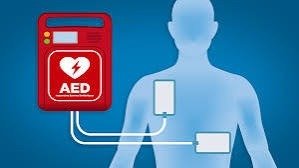
An Automated External Defibrillator (AED) is a portable electronic device designed to treat sudden cardiac arrest by delivering a controlled electric shock to the heart. In simple terms, an AED analyzes the heart’s rhythm and, if it detects a life-threatening arrhythmia (like ventricular fibrillation), it administers a shock to help the heart re-establish an effective rhythm . These devices are meant to be user-friendly – even people with minimal training can operate them. In fact, modern AEDs provide clear voice and visual prompts to guide rescuers through each step, so no formal training is required to use one in an emergency . This ease of use is by design: during a cardiac emergency every second counts, and AEDs allow bystanders to act quickly while waiting for professional help to arrive. Using an AED promptly, in combination with CPR, can literally be the difference between life and death – each minute of delay in defibrillation reduces the chances of survival by about 10% . That’s why AEDs have become such a crucial part of the first aid toolkit in public spaces and workplaces.
A Brief History of Defibrillators and AEDs
The journey of the defibrillator from a bulky hospital machine to the compact AEDs we see in shopping centers and offices today is a fascinating story of medical innovation. Defibrillation (using electric shocks to reset the heart) was first developed in the mid-20th century for hospital use. Early defibrillators were large, manual devices with paddle electrodes – effective in skilled hands, but not portable.
A major breakthrough came in the 1960s thanks to Professor Frank Pantridge of Belfast. In 1965, Pantridge introduced the first truly portable defibrillator, installing a 70 kg unit in an ambulance (powered by car batteries!) to create a mobile coronary care unit . By 1968 he had dramatically improved the design, developing a defib that weighed only 3 kg – small enough to be practical in emergency vehicles . Pantridge’s pioneering vision was to bring lifesaving defibrillation to the patient, rather than waiting until the patient reached a hospital. His “Pantridge Plan” proved that early pre-hospital care for cardiac arrest could save many lives, and it inspired emergency services around the world to start equipping ambulances with defibrillators . This eventually led to the development of the automated external defibrillator (AED), a device safe for use by laypeople due to automated rhythm analysis and guided prompts .
Despite these advances, adoption was initially slow. Astonishingly, Pantridge noted that it wasn’t until 1990 that all front-line ambulances in the UK were finally equipped with defibrillators . Other parts of the world, including Australia, were also gradually realizing the importance of defibs in the field. Public awareness of sudden cardiac arrest and the push for public access defibrillation (placing AEDs in public venues) really began to grow in the 1990s and 2000s. Today, we take for granted that we might see an AED in an airport or have one handy at a sports event, but it took decades of advocacy and some pivotal events to reach this point.
The Kerry Packer Incident that Transformed NSW Ambulances
One of the most significant events in Australia’s AED history was triggered by an unlikely source – a billionaire media mogul named Kerry Packer. In 1990, Kerry Packer (then one of Australia’s richest men) suffered a massive heart attack and collapsed during a polo match. By sheer luck, the ambulance that arrived to treat him was one of the very few in New South Wales that carried a defibrillator at the time. The paramedics used that defib to shock Packer’s heart back to life, essentially saving him from sudden cardiac death on the spot.
Packer’s brush with death became the catalyst for dramatic change. Grateful for his second chance, he famously told the New South Wales Ambulance Service, “I’ll gladly pay for these devices if it means more lives can be saved.” True to his word, later that year Packer donated $2.5 million to fund the purchase of defibrillators for every ambulance in NSW . This act equipped dozens of emergency vehicles with AEDs or portable defibs virtually overnight. The new fleet of life-saving devices earned a cheeky nickname in Aussie folklore – they were called “Packer Whackers” in honor of the man who funded them ! It’s estimated that this gesture by Packer has since saved thousands of lives, as ambulances across the state (and eventually the nation) could now deliver prompt defibrillation to cardiac arrest victims wherever they might be .
The impact of Packer’s donation cannot be overstated. It brought defibrillation into the spotlight for the general public and other states as well. New South Wales set a precedent in the early ’90s that others soon followed – making AEDs standard equipment in ambulances, and later, advocating for AEDs in public places. In a very real sense, Kerry Packer’s incident helped jump-start the wider public access defibrillator movement in Australia. Today, thanks to efforts like this, it’s far more likely that if someone suffers a cardiac arrest in the community, an AED is nearby or carried by first responders, ready to deliver that lifesaving “whack” to restart their heart.
Paramedics resuscitating a patient with a defibrillator in an ambulance. Kerry Packer’s survival story prompted NSW ambulances to carry defibs on every call-out, turning rare devices into standard gear.
When (and How) to Use an AED – Following ARC Guidelines
Knowing when to attach and use an AED is a critical piece of first aid knowledge. The Australian Resuscitation Council (ARC), through the ANZCOR guidelines, provides clear advice on this. In a first aid scenario, you should consider using an AED only when a person is unresponsive and not breathing normally – in other words, if you suspect cardiac arrest . This fits into the familiar DRSABCD action plan taught in first aid:
• D – Danger: Ensure the area is safe.
• R – Response: Check if the person is responsive.
• S – Send for help: Call emergency services (000 in Australia).
• A – Airway: Make sure the airway is clear.
• B – Breathing: Check for normal breathing. (If not breathing or not breathing normally, proceed to CPR and defib.)
• C – CPR: Start CPR (30 compressions : 2 breaths) immediately if the person is unconscious and not breathing.
• D – Defibrillation: Attach an AED as soon as it is available and follow its prompts .
The key point is to get the AED on and activated as quickly as possible once you’ve called for help and started CPR. The ARC Guideline 7 emphatically states that “a defibrillator should be applied to the person who is unresponsive and not breathing normally as soon as it becomes available so that a shock can be delivered if necessary” . Every minute counts, so you don’t delay CPR or defib waiting for a perfect moment – if a second rescuer is present, have them set up the AED while CPR continues . If you’re alone, grab an AED quickly if one is very close by; otherwise start CPR first and use an AED as soon as someone brings it to you.
Using an AED is straightforward: turn the device on, attach the adhesive pads to the patient’s bare chest as shown on the pad diagrams, and let the AED analyze. The machine will detect the heart rhythm and either advise a shock (which you deliver by pressing the shock button when prompted) or announce that no shock is needed. Then resume CPR immediately until help arrives or the person shows signs of life. The ARC (and all international guidelines) stress minimizing interruptions in chest compressions – so pad placement and any shocks should be done as briskly as possible, with CPR paused only when absolutely necessary (like during the shock). Modern AEDs often talk you through these steps with voice instructions, which is a great help to keep even a panicked rescuer on track . Remember, AEDs are very safe and designed to only deliver a shock if it’s truly needed – you cannot accidentally shock someone who has a normal heartbeat. So as the ARC says: don’t hesitate to use an AED on an unresponsive non-breathing person. Any attempt at resuscitation is better than no attempt.
Meet CellAED – The World’s Smallest Personal AED
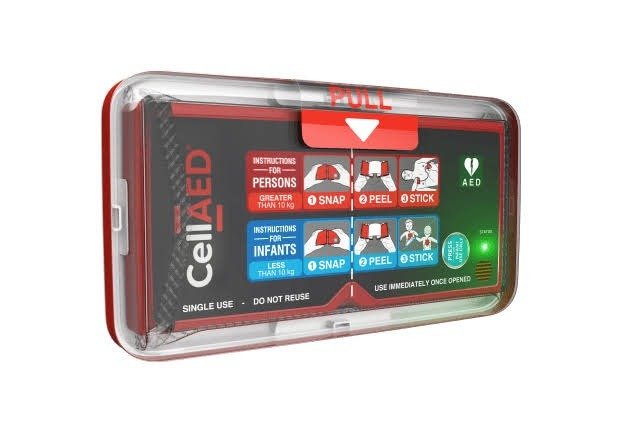
AED technology has continued to evolve, and today we’re seeing devices that were unimaginable decades ago. One exciting development is the CellAED, billed as the world’s first handheld personal AED. CellAED is essentially a defibrillator shrunk down to about the size of a smartphone, intended for home or personal use in the event of sudden cardiac arrest. This device, developed by the Australian company Rapid Response Revival, exemplifies how far defibrillators have come – from 70 kg machines in the 1960s to a pocket-sized gadget in the 2020s!
So what makes the CellAED special? First, its compact size means it can be kept almost anywhere – in your home first aid kit, glovebox, handbag, or office drawer – so you have an AED on hand at all times, not just relying on public ones. It’s a “smart” AED with built-in voice prompts and a very simple activation method. Instead of opening a case and fiddling with buttons, the CellAED is used by “Snap, Peel, Stick”: you snap the device in half along a perforated line to turn it on, peel off the protective cover to reveal the pads, and stick the pads onto the patient. The act of snapping it open triggers the device and its voice guidance system . From there, it works like any AED – it automatically analyzes the heart rhythm and will deliver a shock if it detects a shockable cardiac arrest rhythm . The design is meant to be foolproof under pressure, which is critical in chaotic emergencies.
Given the grim statistics of cardiac arrest (around 30,000 out-of-hospital cardiac arrests occur annually in Australia, with survival rates in the single digits without intervention), having a personal AED like CellAED could be a game-changer for improving survival at home. If an ambulance takes 10 minutes to arrive, a bystander with a CellAED could deliver a lifesaving shock at minute 3 or 4 – hugely improving the victim’s odds. It’s important to note that the CellAED is to be used in conjunction with CPR, not a replacement for it. You still need to call for an ambulance and do chest compressions, but this device buys time by restoring some circulation earlier in the chain of survival.
The CellAED is now available to the public. For those interested in this cutting-edge lifesaver, you can purchase a CellAED through authorized distributors – for example, it’s available via GJS Business Solutions and Training (Gary Spokes) in Australia. (Buy the CellAED here to learn more about pricing and details.) Being prepared with an AED in your home or workplace is becoming the new frontier of first aid, and devices like CellAED are leading the way.

The Future: How AI Could Make AEDs Even Smarter
What’s next for AEDs? One exciting avenue is the integration of Artificial Intelligence (AI) to make these devices even more effective and intuitive. Future AEDs might do a lot more than just analyze a heart rhythm. Here are some ways AI could enhance AED functionality in the coming years:
• Even More Accurate Rhythm Analysis: Current AED algorithms are very good, but AI and machine learning could further refine the detection of shockable rhythms versus non-shockable ones. Smarter analysis means fewer false shocks and better recognition of when a shock is truly needed . This could especially help in noisy environments or during movement, where artifacts sometimes confuse traditional algorithms. By processing vast datasets of cardiac rhythms, an AI-driven AED could “learn” to recognize cardiac arrest rhythms with near-perfect accuracy.
• Real-Time CPR Feedback: Some advanced defibrillators already give feedback on CPR quality (like whether you’re pushing hard and fast enough). AI could take this to the next level – imagine an AED that not only tells you to push harder, but analyzes the patient’s response in real time and guides you on optimal compression depth or rate. AI-enabled devices might encourage a rescuer step-by-step (“Press a little faster… good, keep that rhythm!”) in a calm, coached manner . This kind of interactive guidance could be hugely reassuring for untrained rescuers and could improve the quality of CPR delivered.
• Adaptive Decision-Making: In the future, AEDs might incorporate additional data about the patient if available – perhaps through a synced smartphone app or medical wearables. For example, an AI AED might access the patient’s known medical history or use other sensors (like oxygen levels or motion) to adapt its instructions. While today’s AEDs follow a one-size-fits-all protocol, a future device could tailor its prompts (“administering a second shock now based on analysis”) using adaptive learning from past resuscitations .
• Predictive Maintenance and Readiness: AI isn’t just for during the rescue – it can help in keeping AEDs ready to use. Many AEDs sit on walls for months or years and are only as good as their battery life and self-test status. AI could enable predictive maintenance, meaning the AED can anticipate when its battery or pads are nearing expiry or if any component is likely to fail, and alert owners or central systems ahead of time . This ensures that the device will work when it’s truly needed, reducing the chance of finding a dead battery in an emergency. It also could streamline the management of large fleets of public AEDs in buildings and cities, by reporting their status and readiness to a cloud system.
• Integration with Emergency Services: We may see AEDs that automatically call for help when opened, or even live-stream data to emergency dispatchers. AI could assist in transmitting EKG readings to the hospital so doctors can prepare, or in pinpointing the user’s location via GPS for faster ambulance dispatch. Some AED drone delivery programs are already testing AI for dispatching an AED to your location when you call for help. All this would make the chain of survival even more efficient.
From these possibilities, it’s clear that tomorrow’s AEDs will be more connected, more intelligent, and even easier for lay rescuers to use. The core mission will remain the same – save lives from sudden cardiac arrest – but AI can boost the odds by reducing human error and customizing care in those critical few minutes . It’s amazing to think that a device which was once just a box that delivers a shock might soon become a talking, thinking digital assistant in a crisis. As technology advances, we move closer to a future where collapsing from a cardiac arrest isn’t a likely death sentence, because help – possibly AI-guided help – is immediately at hand.
Contact Information
For more information on AED products, first aid training, or to discuss bringing life-saving devices like the CellAED into your community or workplace, you can contact Gary Spokes, Managing Director of GJS Business Solutions and Training:
• Phone: 0435 901 221
• Email: [email protected]
Gary and the team at GJS Business Solutions and Training are specialists in first aid training and equipment in NSW, and can provide guidance on choosing the right AED for your needs, training in CPR/AED usage, as well as information on the latest developments in emergency response. Don’t hesitate to reach out – being informed and prepared could one day save a life.
References:
1. Red Cross – What is an AED? Used for Sudden Cardiac Arrest .
2. Healthdirect Australia – How to perform CPR (includes AED steps) .
3. American Red Cross – CPR Facts & Statistics (importance of early AED use) .
4. Forbes Australia – Article on Kerry Packer and defibrillator funding .
5. Wikipedia – Frank Pantridge biography (portable defibrillator history) .
6. ANZCOR Guideline 7 – Automated External Defibrillation in Basic Life Support .
7. Futurò Prossimo – CellAED: smartphone-sized defibrillator .
8. Defib Supplies (Blog) – How AI Can Revolutionise AEDs .